
Meaning of Jenkins Property Values
In Jenkins County, one address can carry several values that answer different questions. The Board of Tax Assessors sets fair-market and assessed figures for tax administration. A deed or PT-61 filing records what changed hands in a sale. A private appraisal serves a lender or owner. It applies to a stated date and purpose. Keep the source attached to every number. That habit alone prevents most bad comparisons.
| Value | What It Is | Where |
|---|---|---|
| Fair-market value | The assessor's full-value estimate at the annual valuation date | Board of Tax Assessors / qPublic |
| Assessed value | Generally 40 percent of fair-market value before exemptions or special treatment | Assessor record |
| Last sale price | A reported transfer figure that may not represent an open-market sale | Deed, PT-61, or assessor sale field |
| Land and improvements | Separate components that may add to a total value | Assessor parcel card |
Georgia applies a general assessment ratio of 40 percent. Jenkins County explains it with a simple example: a $100,000 fair-market figure becomes a $40,000 assessed value before exemptions or classifications apply. The ratio works one way only. It does not predict a sale price. It also cannot turn a deed's transfer figure into an official fair-market finding.
Jenkins Value Date and Roll
Jenkins County sets its general valuation date on January 1. The qPublic landing page notes that assessment figures come from the last certified tax roll, while other details may shift over time. Every value therefore carries two labels: the tax year it belongs to and the date someone pulled it up.
The county publishes no fixed portal refresh interval and no official annual value trend for its assessment data. One screen may show a certified roll, another a later correction, and a third a field updated on its own schedule. Compare like years and like classifications whenever you check values.
Note: A newer lookup does not make an older assessment year current; record both the value year and the date you saw it.
Jenkins 40 Percent Rule
The official Jenkins tax information page publishes the 40 percent assessment rule alongside the county tax calendar.
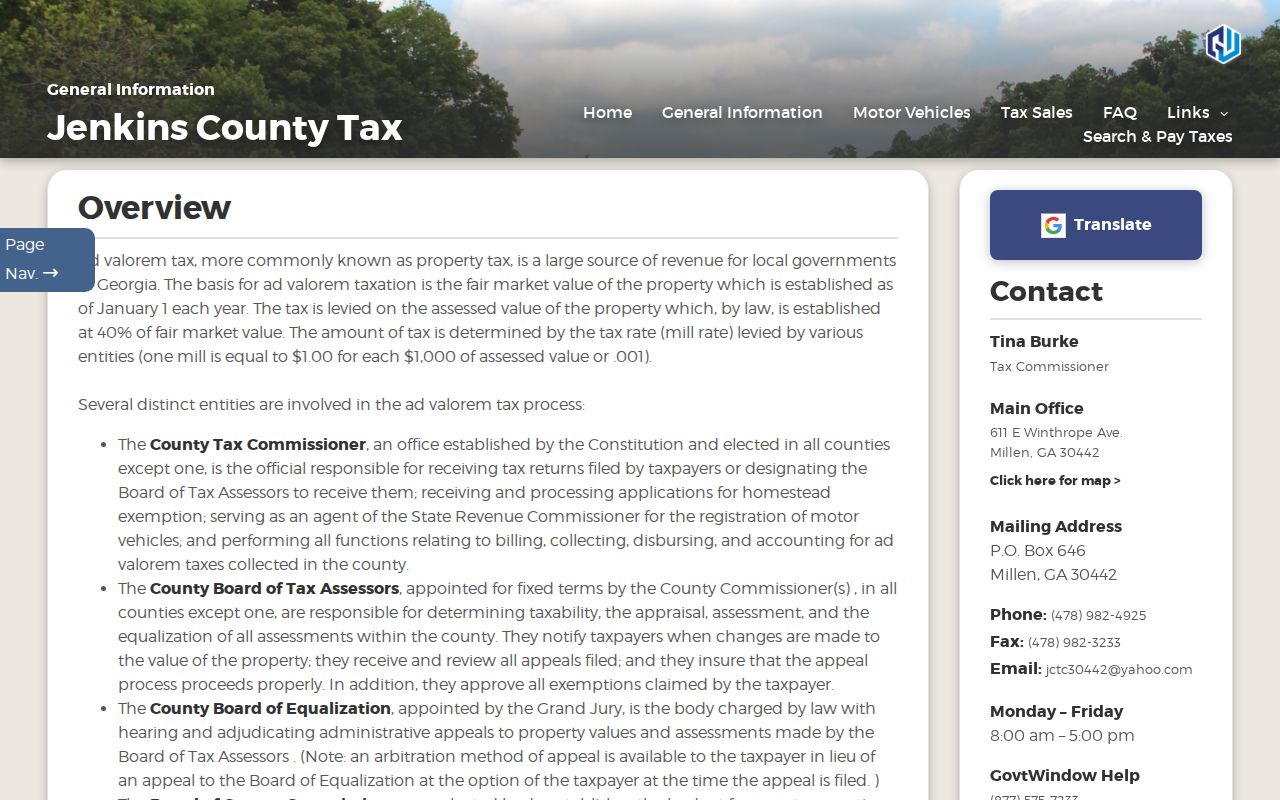
That rule builds the tax formula. It says nothing about one parcel's value, which comes only from that parcel's own record.
Jenkins Property Value Components
A Jenkins County parcel card typically lists land value, improvement value, total fair-market value, total assessed value, acreage, classification, tax district, exemptions, and sale history. The live Schneider card does not always load, and its exact field order and wording can differ from other counties' displays. Write down the labels exactly as shown.
- Fair-market value
- The assessor's full-value estimate within the annual tax system.
- Assessed value
- The figure produced under the assessment ratio before applicable exemptions.
- Assessment ratio
- The percentage connecting fair-market and assessed value under the general rule.
- Consideration or sale price
- A transfer figure that requires deed and transaction context.
- Reassessment
- A new or revised official value for a tax cycle, not a private appraisal.
Land and improvements move on separate tracks. A new building, a parcel split, a homestead exemption, a conservation covenant, or a reclassification can push one year's total far from a neighbor's comparable figure.
Jenkins Classified Property Values
Classified programs can break that link in Jenkins County. They can separate full value from taxable value. County materials point to bona fide agricultural property, conservation use, and forest land protection. Homestead, elderly, disabled-veteran, and surviving-spouse provisions also appear. Eligibility rules and covenants drive the numbers. A conservation-use tract should never be judged against an ordinary home by assessed value alone. Note the classification, acreage, exemption, tax year, and any parcel changes first. Qualifying forest tracts over 200 acres fall under a 10-year covenant within the relevant program. Confirm current terms with the assessor's office.
Jenkins Sale Price Context
The GSCCCA PT-61 index searches by buyer or seller and reports sale-price information. Treat it as context, not gospel. PT-61 data can be corrected, and it is not the deed itself. A transfer may be nominal, exempt, or partial. It may be within a family, tied to an estate, or bundled across several tracts. Any of those facts can weaken the price as a measure. It may not reflect one parcel's market value. Read the deed first to confirm parties, deed type, legal description, dates, and parcel references. Then weigh the PT-61 figure once the transaction makes sense. The assessor's value and the transfer amount are parallel records, not interchangeable answers. The Jenkins County property tax record page covers the tax bill. It also covers exemptions, collection, and appeal routes.
Jenkins Value Access Channels
Online access starts with qPublic and its Schneider application. That application sometimes sits behind a Cloudflare barrier, and when it does, the right move is the county fallback rather than assuming no record exists. Call the Board of Tax Assessors at 478-982-4939 and request an existing parcel card, assessment notice, certified-roll extract, or map tied to the exact address and parcel number. Tax Commissioner Tina Burke can supply a tax statement at 478-982-4925, 611 E. Winthrope Avenue, Millen, with mail to P.O. Box 646. The office also lists fax 478-982-3233 and jctc30442@yahoo.com. Verify delivery rules before sending personal or payment data. For a defined data set, send a written Georgia Open Records Act request to County Administrator Grady Saxon. Specify the parcel, the years, the record type, the preferred electronic form, and a fee estimate. Jenkins County Memorial Library and Georgia Archives hold historic leads, not current values.
Checking a Jenkins Property Value
A sound Jenkins County property value check begins with the land, not the number. Match the address to the parcel identifier first. Record the valuation year. Only then compare the value fields. Those steps guard against a similar street name, a parent tract, or an outdated card throwing off the whole comparison.
- Search the Jenkins qPublic route by address or owner when the live application is available.
- Match situs, legal description, acreage, and the parcel or map ID before saving any value.
- Write down the year, fair-market value, assessed value, land and improvement parts, class, and exemptions.
- For sale context, compare the deed and PT-61 record while keeping transfer price separate from assessment.
If no card opens, ask the assessor for the existing parcel record. Never estimate an unseen value by working backward from the 40 percent ratio.
Jenkins Industrial Parcel Caution
Development materials for Millen Industrial Park II, the DW Site, and the Cavalier rail-spur tract talk up acreage, rail, utilities, and zoning. Treat those claims as planning or marketing language. They are not certified values. They are not proof of ownership. The DW conceptual plan even flags wetlands and rough boundaries. That should signal how provisional the numbers are.
Before trusting any figure for a single tract, line up several records. Pull the assessor parcel. Pull the deed and plat, current zoning, a final survey, environmental files, and any development agreements. A conceptual acreage figure never becomes a Jenkins County property value on its own. That local lesson travels: every number has a source and a purpose.
Rail access, wetlands, frontage, and zoning all shape what a buyer will pay. The county development description does not measure those effects. A parcel may also hold multiple tracts or recorded rights. So start any comparison from the same property interest, acreage, date, and use. Then ask whether the sale was truly exposed to the open market. Ask too what improvements existed at closing. Skip that groundwork, and dividing a reported price by advertised acres gives you a tidy, meaningless number.
Limits of Jenkins Assessed Value
An assessed value exists to drive the property-tax process. It is not a sale-price forecast. It is not a boundary ruling, a title opinion, or a private appraisal. Even the assessor's fair-market figure carries a valuation date and a mass-appraisal purpose. A recent renovation, storm damage, an odd easement, a partial transfer, or a protected-use class may rest on facts no summary card can show.
For a property-specific appraisal, hire a qualified Georgia appraiser. Boundary questions belong with a surveyor. Recorded rights live in the clerk's deed records.
A value dispute also demands evidence pinned to the assessment date. Photos, repair records, a survey, and comparable sales can explain condition or uniformity, while a tax portal screenshot only preserves what appeared on screen. The assessment notice controls the appeal clock. The Board of Tax Assessors decides the value; the Tax Commissioner does not set that figure. Keeping those functions straight saves time and sends each records request to the right office.
Value is not price. A Jenkins County assessed value is for taxation and does not predict a sale or replace a licensed appraisal.